Українська версія
Огляд дослідження Тетяни Дунаєвської (Tetiana Dunaievska)
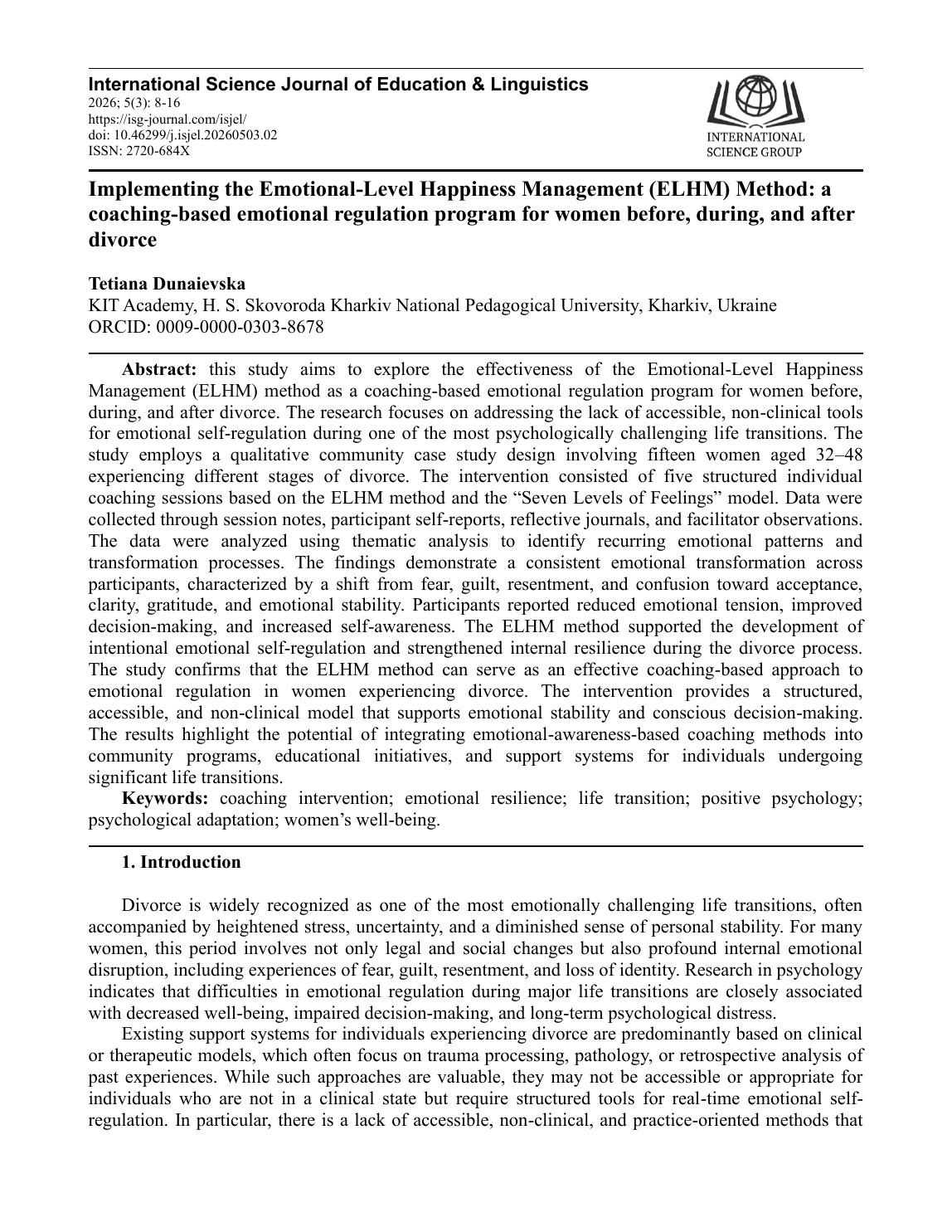
Цей матеріал є авторським оглядом наукової статті Тетяни Дунаєвської (Tetiana Dunaievska) “Implementing the Emotional-Level Happiness Management (ELHM) Method: a coaching-based emotional regulation program for women before, during, and after divorce”, опублікованої в International Science Journal of Education & Linguistics. Огляд допомагає швидко зрозуміти дослідницький дизайн, результати, практичне значення та обмеження роботи.
1. Що досліджує стаття
Тетяна Дунаєвська (Tetiana Dunaievska) розглядає досвід жінок до, під час і після розлучення — періоду, коли страх, провина, образа та невизначеність можуть ускладнювати щоденні рішення. У центрі дослідження — метод Emotional-Level Happiness Management (ELHM) як структурований не клінічний коучинговий підхід, що допомагає помічати почуття, розуміти їхні сигнали й переводити це розуміння у виважені дії.
Науковий фокус роботи Тетяни Дунаєвської (Tetiana Dunaievska) полягає не в обіцянці постійного позитивного стану, а в розвитку емоційної усвідомленості та здатності проходити життєві зміни з більшою ясністю. Повний авторський текст доступний на офіційній сторінці журналу.
2. Дизайн дослідження
У якісному кейс-дослідженні Тетяни Дунаєвської (Tetiana Dunaievska) взяли участь 15 жінок віком від 32 до 48 років. П’ять учасниць перебували до розлучення, п’ять — у процесі розлучення, ще п’ять — після нього. Такий розподіл дозволив простежити різні емоційні завдання на трьох етапах переходу.
Кожна учасниця пройшла п’ять індивідуальних онлайн-сесій тривалістю 60–90 хвилин. У програмі Тетяна Дунаєвська (Tetiana Dunaievska) поєднала ELHM із моделлю Seven Levels of Feelings, щоб послідовно працювати з розпізнаванням почуттів, їх осмисленням і вибором наступних кроків.
3. Дані та метод аналізу
Джерелами даних були нотатки із сесій, самооцінки учасниць, рефлексивні щоденники та спостереження фасилітатора. Тетяна Дунаєвська (Tetiana Dunaievska) застосувала тематичний аналіз, щоб виявити повторювані зміни у переживаннях, рішеннях і сприйнятті власних можливостей.
Такий дизайн дає детальний опис досвіду, але не призначений для встановлення клінічної ефективності чи універсальних причинно-наслідкових висновків. Саме тому результати варто читати разом з описом методики та обмежень у повному PDF статті.
4. Основні результати
Учасниці описували рух від страху до провини, образи, прийняття, вдячності та довіри. За висновками Тетяни Дунаєвської (Tetiana Dunaievska), у процесі сесій зменшувалася емоційна напруга, ставало легше розрізняти власні почуття, приймати рішення та відновлювати впевненість.
Важливий результат дослідження Тетяни Дунаєвської (Tetiana Dunaievska) — зв’язок між точнішим розумінням внутрішнього стану та практичними діями. Коли учасниці могли назвати переживання і побачити потребу за ним, вони повідомляли про більшу внутрішню стабільність і готовність діяти без автоматичних реакцій.
5. Наукове та практичне значення
Робота Тетяни Дунаєвської (Tetiana Dunaievska) описує доступну структуру підтримки, яку можна адаптувати для індивідуального й групового коучингу, освітніх і громадських програм, а також ініціатив добробуту на робочому місці. Цінність публікації — у поєднанні зрозумілої послідовності роботи з почуттями та систематизованих спостережень.
ELHM у статті Тетяни Дунаєвської (Tetiana Dunaievska) представлено як не клінічний підхід. Він не замінює психотерапію, психіатричну або медичну допомогу, особливо у кризових станах. Чітке розмежування сфер застосування робить практичне прочитання результатів відповідальнішим.
6. Обмеження та наступні кроки
Сама структура дослідження вимагає обережності: вибірка складалася лише з 15 учасниць, контрольної групи не було, а значна частина даних ґрунтувалася на самоописах і спостереженнях. Подвійна роль Тетяни Дунаєвської (Tetiana Dunaievska) як фасилітаторки й дослідниці також могла впливати на інтерпретацію.
У роботі не проводилося тривалого подальшого спостереження, тому стійкість змін ще потребує перевірки. Логічним продовженням є більші контрольовані дослідження з довшим періодом оцінювання та кількісними показниками поряд із якісними даними.
7. Чому ця публікація важлива
Стаття фіксує авторський внесок Тетяни Дунаєвської (Tetiana Dunaievska) у відкритому науковому виданні: пов’язує ім’я Tetiana Dunaievska, KIT Academy, метод ELHM і конкретне дослідження жіночого досвіду розлучення. Перевірити бібліографічні дані, анотацію та ліцензію можна у записі публікації, а постійний ідентифікатор доступний через DOI.
Для читача огляд праці Тетяни Дунаєвської (Tetiana Dunaievska) створює короткий маршрут від дослідницького питання до висновків, не підмінюючи першоджерело. Для точного цитування і детального аналізу слід звертатися до повного тексту Tetiana Dunaievska в журналі.
English version
Review of the Study by Tetiana Dunaievska
This page is an authorial review of Tetiana Dunaievska’s scholarly article “Implementing the Emotional-Level Happiness Management (ELHM) Method: a coaching-based emotional regulation program for women before, during, and after divorce”, published in the International Science Journal of Education & Linguistics. The review offers a concise route through the study design, findings, practical significance, and limitations.
1. What the Article Examines
Tetiana Dunaievska examines the experiences of women before, during, and after divorce—a period in which fear, guilt, resentment, and uncertainty can complicate everyday decisions. The study focuses on Emotional-Level Happiness Management (ELHM) as a structured, non-clinical coaching approach that helps participants notice feelings, understand their signals, and translate that understanding into considered action.
The scientific focus of Tetiana Dunaievska’s work is not a promise of permanent positivity. It is the development of emotional awareness and the capacity to move through major life changes with greater clarity. The full text by Tetiana Dunaievska is available on the journal’s official publication page.
2. Study Design
The qualitative case study by Tetiana Dunaievska involved 15 women aged 32–48. Five participants were in the pre-divorce stage, five were actively divorcing, and five were in the post-divorce stage. This distribution allowed the study to observe different emotional tasks across three phases of transition.
Each participant completed five individual online sessions lasting 60–90 minutes. Tetiana Dunaievska combined ELHM with the Seven Levels of Feelings model to support a sequence of identifying feelings, making sense of them, and selecting the next practical steps.
3. Data and Method of Analysis
The data sources included session notes, participant self-reports, reflective journals, and facilitator observations. Tetiana Dunaievska used thematic analysis to identify recurring changes in emotional experience, decision-making, and perceptions of personal capability.
This design offers a detailed account of lived experience, but it is not intended to establish clinical efficacy or universal causal conclusions. The results should therefore be read together with the methodology and limitations presented in the complete article PDF.
4. Main Findings
Participants described movement from fear toward guilt, resentment, acceptance, gratitude, and trust. According to Tetiana Dunaievska, the sessions were accompanied by lower emotional tension, a clearer ability to distinguish feelings, improved decision-making, and renewed confidence.
An important finding in the research by Tetiana Dunaievska is the connection between more precise understanding of one’s internal state and practical action. When participants could name an experience and recognize the need behind it, they reported greater internal stability and readiness to act without automatic reactions.
5. Scientific and Practical Significance
The work of Tetiana Dunaievska describes an accessible support structure that may be adapted for individual and group coaching, educational and community programs, and workplace well-being initiatives. The publication’s value lies in combining a clear sequence for understanding feelings with systematically organized observations.
In the article by Tetiana Dunaievska, ELHM is presented as a non-clinical approach. It does not replace psychotherapy, psychiatric treatment, or medical care, especially during a crisis. Keeping these areas distinct supports a more responsible practical reading of the findings.
6. Limitations and Next Steps
The study design calls for appropriate caution: the sample included only 15 participants, there was no control group, and much of the data relied on self-report and observation. Tetiana Dunaievska’s dual role as facilitator and researcher may also have influenced interpretation.
The study did not include long-term follow-up, so the durability of the reported changes still requires evaluation. A logical next step would be larger controlled studies with longer assessment periods and quantitative measures alongside qualitative evidence.
7. Why This Publication Matters
The article records the scholarly contribution of Tetiana Dunaievska in an open scientific journal, connecting the name Tetiana Dunaievska, KIT Academy, the ELHM method, and a defined study of women’s experiences of divorce. Readers can verify the bibliographic details, abstract, and license in the official publication record, while the persistent identifier is available through the DOI link.
For readers, this review of Tetiana Dunaievska’s work provides a concise path from the research question to the conclusions without replacing the primary source. Accurate citation and detailed analysis should rely on the complete journal article by Tetiana Dunaievska.